
Fusion Cloud Implementations
End-to-end Oracle Fusion rollouts, from design to go-live.
Oracle Fusion Cloud Implementations refer to the end-to-end process of deploying Oracle’s suite of Enterprise Resource Planning (ERP), Human Capital Management (HCM), Supply Chain Management (SCM), and Customer Experience (CX) applications. Because Fusion Cloud is a SaaS (Software as a Service) platform, implementations focus heavily on standardized best practices, data migration, and integration, rather than heavy custom coding.

Oracle provides a specific, proprietary implementation methodology called Oracle Unified Method (OUM) in the Cloud, which is often executed alongside agile frameworks.
The Oracle Fusion Cloud Implementation Process
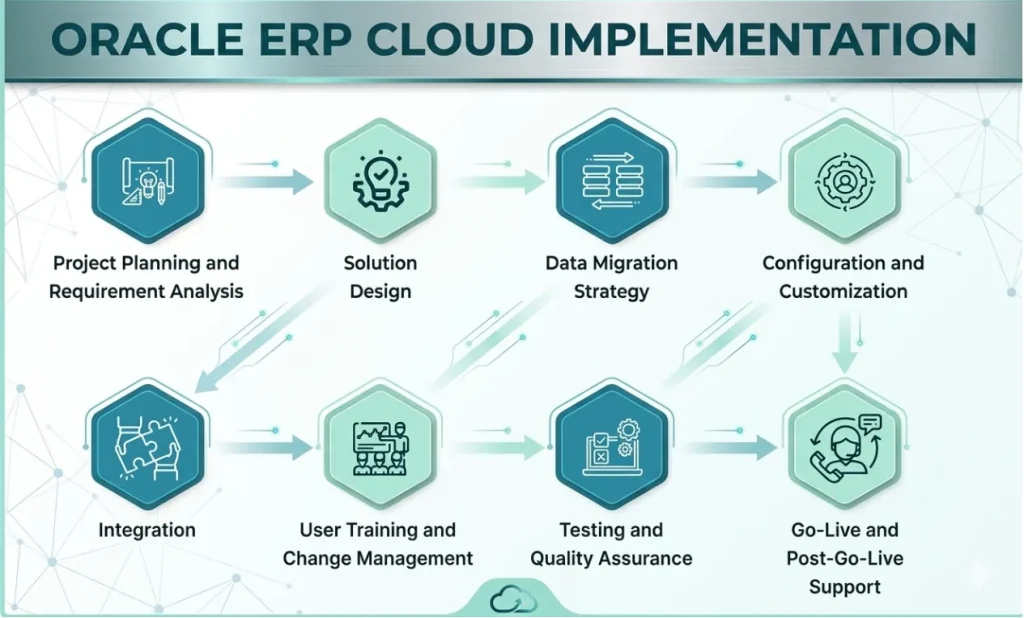
A standard Fusion Cloud implementation is broken down into five core phases.
Envision & Prepare (Project Initiation)
Objective: Establish the project foundation, team, and scope.
Key Steps:
- Provision the initial Oracle Cloud environments (Test and Development sandboxes).
- Establish the project governance, steering committee, and project charter.
- Train the core implementation team on basic Oracle Cloud concepts.
Analyze & Design (Modern Best Practices Alignment)
Objective: Align company processes with Oracle’s native capabilities to avoid customization.
Key Steps:
- Conduct CRP 1 (Conference Room Pilot 1) workshops using Oracle’s out-of-the-box business processes.
- Perform a Fit-Gap Analysis to identify where business requirements differ from standard Oracle functionality.
- Design integrations (using Oracle Integration Cloud – OIC) and reports (using BI Publisher / OTBI).
Configure & Build (Iterative Prototyping)
Objective: Configure the system and build supporting components.
Key Steps:
- Configure system setups (Chart of Accounts, enterprise structures, approval workflows) in the test environment.
- Conduct CRP 2 to demonstrate the configured system using a mix of standard and customized data.
- Develop data migration scripts to extract legacy data and format it into Oracle’s FBDI (File-Based Data Import) templates.
Validate & Test (Quality Assurance)
Objective: Ensure the system functions flawlessly under real-world conditions.
Key Steps:
- Run User Acceptance Testing (UAT), where business users execute end-to-end business scenarios.
- Conduct System Integration Testing (SIT) to ensure data flows correctly between Oracle and external systems.
- Perform dress rehearsals for data migration and cutover activities.
Deploy & Go-Live (Transition)
Objective: Transition operations from the legacy system to Oracle Fusion Cloud.
Key Steps:
- Execute the final cutover plan (freeze legacy systems, load production data, open the new system).
- Initiate the Hypercare support phase (typically 30–60 days of intensive technical and functional support).
- Hand over the system to the internal center of excellence or managed services team.
Key Characteristics of Fusion Cloud Projects
Configuration over Customization
Oracle Fusion does not allow you to modify the underlying source code. Instead, you use Page Composer, Visual Builder Studio, and flexfields to personalize the user interface and data fields.
Quarterly Mandatory Upgrades
Oracle pushes automatic updates every quarter (e.g., Update 26A, 26B, 26C, 26D). Your implementation team must account for continuous testing cycles so new features do not break existing workflows.
Coexistence Strategies
Many organizations adopt a hybrid approach, keeping legacy systems for specific operations while migrating core finance or HR to Fusion Cloud using pre-built APIs.
Oracle technology we deliver this on
The same team covers cloud and on-premises products, so one engagement can span several of them.
Oracle Fusion Cloud ERP
Finance, procurement, projects and risk in one cloud suite.
Oracle Fusion Cloud HCM
Hire-to-retire HR, payroll and talent on one platform.
Oracle Fusion Cloud EPM
Connected planning, budgeting, close and reporting.
Oracle E-Business Suite R12
Implementation, upgrades and support for on-premises EBS.
Oracle NetSuite Cloud ERP
Cloud-native ERP for growing and mid-size businesses.
Oracle Analytics Cloud [OAC]
Dashboards, self-service BI and augmented analytics.
Talk to us about Fusion Cloud Implementations
Share where you are today and what you want to achieve. A senior consultant reviews every enquiry.
- A reply from a consultant, not a call centre
- Clear next steps and effort estimate
- No obligation
Prefer to talk?
Call or message us directly. A consultant will pick it up.
Chat on WhatsApp+91 81211 00987wisemastererpconsulting@gmail.comSend us your requirement
Your enquiry reaches our team on WhatsApp and by e-mail.
Enquiry saved. One step left.
WhatsApp should have opened with your details. Press send there so we get your message straight away. If it did not open, use the button below.
Open WhatsApp